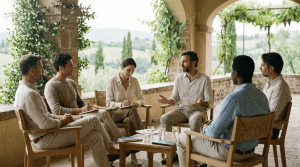

Remote and hybrid work has solved many operational challenges for modern organizations, particularly in terms of flexibility, access to talent, and scalability. At the same time, it has introduced subtler structural issues that are harder to diagnose, and even harder to address through digital means alone.
Many CEOs notice that alignment takes longer to achieve, trust feels more fragile, and decision-making requires more explanation than before. These signals often appear even when performance indicators still look healthy. They are not a sign that remote work is failing, but that something essential is missing.
Distributed teams do not lose competence as they grow. What they lose is shared context. Without regular, lived experiences, leadership becomes more effortful, culture turns abstract, and collaboration risks becoming purely transactional. Corporate retreats are frequently suggested as a response, yet many fail to produce lasting impact. The problem is rarely the idea of meeting in person, but the lack of clarity around how that time should be used.
Why retreat formats matter more than ever
In co-located organizations, alignment and culture are reinforced continuously through everyday interactions. In remote environments, these elements must be reinforced intentionally, or they slowly erode. Digital tools are efficient, but they struggle to convey nuance, shared meaning, and informal understanding. Over time, this gap becomes visible in how teams interpret priorities and how leaders experience their role.
For distributed organizations, in-person time is limited and therefore valuable. This scarcity raises the stakes. When teams come together without a clear purpose or structure, the result often feels symbolic rather than useful. Well-designed retreat formats, by contrast, allow a few days together to recalibrate months of remote collaboration. The difference lies almost entirely in how the retreat is framed and designed.
The core mistake: treating retreats as events, not instruments
Many companies still approach retreats as social events with a professional veneer. They choose an attractive location, assemble a loose agenda, and hope that a mix of workshops, meals, and activities will naturally create alignment. This approach can work for teams that already share strong daily context. For remote teams, it usually falls short.
Effective corporate retreat formats for remote teams treat in-person time as a leadership instrument. They are designed to do specific work that cannot be done remotely. This requires a clear diagnosis of what the organization needs most at that moment. Fewer objectives, sharper intent, and deliberate design consistently lead to better outcomes than broad, unfocused agendas.
Format one: The alignment retreat
The alignment retreat is designed to reduce strategic drag within distributed organizations. As companies grow, assumptions diverge, even when leaders believe they are aligned because they use the same language. Over time, these small differences in interpretation accumulate and slow execution. An alignment retreat brings the leadership group together to clarify priorities, surface tensions, and make decisions that carry authority beyond the room.
This format is not about ideation or inspiration. It is a working retreat with a structured agenda and facilitated conversations aimed at resolution. Quiet settings are particularly effective, as they support focus and reduce distraction. Regions such as Umbria or South Tyrol offer a pace and atmosphere that naturally encourage reflection and disciplined thinking. The outcome is coherence that shows up later in faster decisions and fewer clarifications.
Format two: The trust and connection retreat
Trust decays differently in remote teams than in co-located ones. Open conflict is rare, but distance grows, assumptions harden, and collaboration becomes cautious. A trust and connection retreat is designed to rebuild relational capital without forcing artificial intimacy. Its goal is to restore a sense of human context that digital communication often strips away.
The structure of this format is lighter, but it remains intentional. Carefully designed shared experiences create space for people to see one another beyond functional roles. Italy offers natural advantages here, particularly through its culinary culture. Shared cooking or long, unhurried meals in regions like Tuscany or Emilia-Romagna create connection without pressure. The result is communication that feels more generous and collaboration that becomes less transactional.
Format three: The execution and focus retreat
Some remote organizations are aligned and connected but struggle with focus. They carry too many initiatives and priorities, which dilutes impact and exhausts teams. The execution and focus retreat is designed to simplify. It creates space for honest assessment of what is working, what is stalled, and what should be stopped altogether.
This format is practical and grounded in delivery. Metrics are reviewed, trade-offs are discussed openly, and ownership is clarified. Settings that feel open and energizing without being distracting tend to work well. Coastal regions such as Puglia or Liguria provide this balance. After such a retreat, teams return with fewer priorities and clearer direction, which makes remote execution significantly lighter.
Format four: The culture and identity retreat
As remote organizations mature, culture often becomes conceptual rather than lived. Values are articulated, but daily behaviors vary widely across teams and locations. A culture and identity retreat addresses this gap by creating space for shared reflection. It asks what kind of organization the company is becoming and what it intends to protect as it grows.
These conversations require psychological safety and careful facilitation. They cannot be rushed or improvised. Italy’s historical depth offers a subtle but powerful backdrop for this work. Cities like Florence or Rome illustrate how identity can evolve without losing coherence. The outcome is not a revised values document, but a shared narrative that leaders can carry into everyday decisions.
Format five: The integration retreat after change
Remote teams manage structural change efficiently, but the human impact often remains unprocessed. Mergers, rapid hiring, leadership transitions, or strategic shifts create fragmentation that digital communication rarely resolves. An integration retreat is designed to absorb change rather than accelerate past it. It allows leaders and teams to acknowledge what has shifted and align around what comes next.
Neutral, calming locations support this work particularly well. Lake regions such as Lake Garda or Lake Como signal importance without creating pressure. The agenda balances reflection with forward planning, helping participants place themselves within the new structure. The result is continuity, which prevents parallel cultures from forming unnoticed.
Why Italy works particularly well for remote team retreats
Italy is not the source of a retreat’s value, but it supports that value in important ways. Its geography allows for meaningful contrast without long transfers, and its culture encourages presence rather than constant stimulation. Conversations unfold naturally, and meals create rhythm rather than interruption. For teams accustomed to abstract digital environments, this groundedness matters.
Equally important, Italy allows retreats to feel intentional rather than extravagant. This distinction is critical for credibility, especially with senior teams. The setting supports focus and reflection without becoming the point of the experience.
The before and after of a well-designed retreat
Before a well-designed retreat, remote teams often experience friction that is difficult to articulate. Meetings feel heavier, alignment requires repetition, and trust is assumed rather than felt. These issues rarely appear urgent, but they accumulate over time. Left unaddressed, they make leadership more effortful than necessary.
After the right retreat format, something shifts. Conversations become more direct, decisions travel faster, and teams reference shared experiences rather than documents. Leadership feels lighter because context has been restored. While this effect is not permanent, it creates a meaningful reset that remote organizations can build on.
Choosing the right format is a leadership decision
There is no universal best retreat format for distributed teams. There is only the format that fits the organization’s current moment. Leadership’s role is to diagnose honestly whether the challenge is alignment, trust, focus, integration, or identity. Once that clarity exists, the retreat becomes a strategic instrument rather than a symbolic gathering.
This framing is where most organizations struggle. Execution is rarely the issue. Clarity of intent is.
When considering an in-person moment for a distributed team, it can be helpful to pause before thinking about dates or destinations. Clarifying what the organization truly needs at this point often reshapes the entire conversation. That reflection is usually where meaningful retreat design begins.