Most teams have experienced it.
A carefully planned offsite. A beautiful location. Thoughtful activities. Good conversations over dinner.
People return feeling lighter, more connected, and briefly optimistic. Then, within weeks, daily routines reassert themselves. Decisions slow down again. Collaboration feels no easier. Old patterns quietly return.
For HR and Team Leads, this creates a familiar tension. Considerable effort and budget go into team retreats, yet the actual impact on how teams work together often remains vague. The experience feels positive, but its value is hard to articulate, justify, or build upon.
Why the Question of Outcomes Matters More Than Ever
The context in which teams operate has changed.
Hybrid work, distributed teams, faster growth cycles, and continuous transformation have altered how collaboration, trust, and accountability are built. Informal alignment no longer happens automatically in hallways or over lunch. It has to be designed deliberately.
In this environment, retreats have taken on new importance. They are often one of the few moments when a team is fully present together. Expectations are (understandably) high. HR hopes for cultural reinforcement. Team Leads look for better coordination and clarity. Leadership wants to see engagement translate into performance.
At the same time, pressure has increased. Budgets are scrutinized. Time away from operations needs justification. Vague goals like “bonding” or “motivation” feel increasingly insufficient. Decision-makers want to understand what actually changes after a retreat, and why.
This tension explains why the concept of team retreat outcomes has become increasingly relevant. It shifts the conversation from whether retreats are enjoyable to whether they are effective.
Why Many Offsites Feel Good but Change Nothing
The problem rarely lies in effort or intent. Most HR teams and Team Leads care deeply about creating meaningful experiences. The issue lies in how retreats are framed and designed.
Many offsites start with logistics rather than objectives. The location is chosen first. The agenda is filled with activities that sound engaging. Time is allocated generously for informal interaction. These elements can create a pleasant atmosphere, but they do not automatically influence how a team works once everyone is back at their desks.
Another common issue is misaligned expectations. HR may hope to strengthen culture and belonging. Team Leads may want clearer roles or faster decision-making. Participants may simply want a break from routine. Without an explicit and shared understanding of what should be different afterward, the retreat becomes a container for many intentions, but a driver of few outcomes.
There is also a tendency to avoid difficult topics. Offsites are often framed as a positive space, which can make teams hesitant to address friction, unresolved conflicts, or structural issues. Yet these are precisely the elements that shape daily collaboration. When they remain untouched, the retreat cannot meaningfully alter how work happens.
In regions like Lombardy or the Veneto, where many Italian family-owned companies have long traditions of structured leadership gatherings, offsites historically served a clear purpose. They were moments to recalibrate direction, clarify authority, and align priorities. The social element supported this work, but did not replace it. Modern retreats often invert that balance.
A Different Starting Point: From Experience to Intention
Designing retreats that change how teams work requires a different starting point. Instead of asking what the team should do during the offsite, the more useful question is, “What should be different after the offsite is over?”
This shift may sound subtle, but it has profound implications. It moves the retreat from being an event to being an intervention. The agenda becomes a means, not the goal.
Outcome-driven design starts by clarifying which aspects of teamwork are currently limiting effectiveness.
Is it slow decision-making? Unclear ownership? Lack of trust across functions? Misalignment between leadership intent and team execution?
These are not abstract cultural questions. They are practical issues that show up in meetings, projects, and results.
Once these issues are articulated, the retreat can be designed to address them head-on. Conversations then get structured with purpose. Activities are selected for what they unlock, not how entertaining they are. Reflection is anchored in actual work situations.
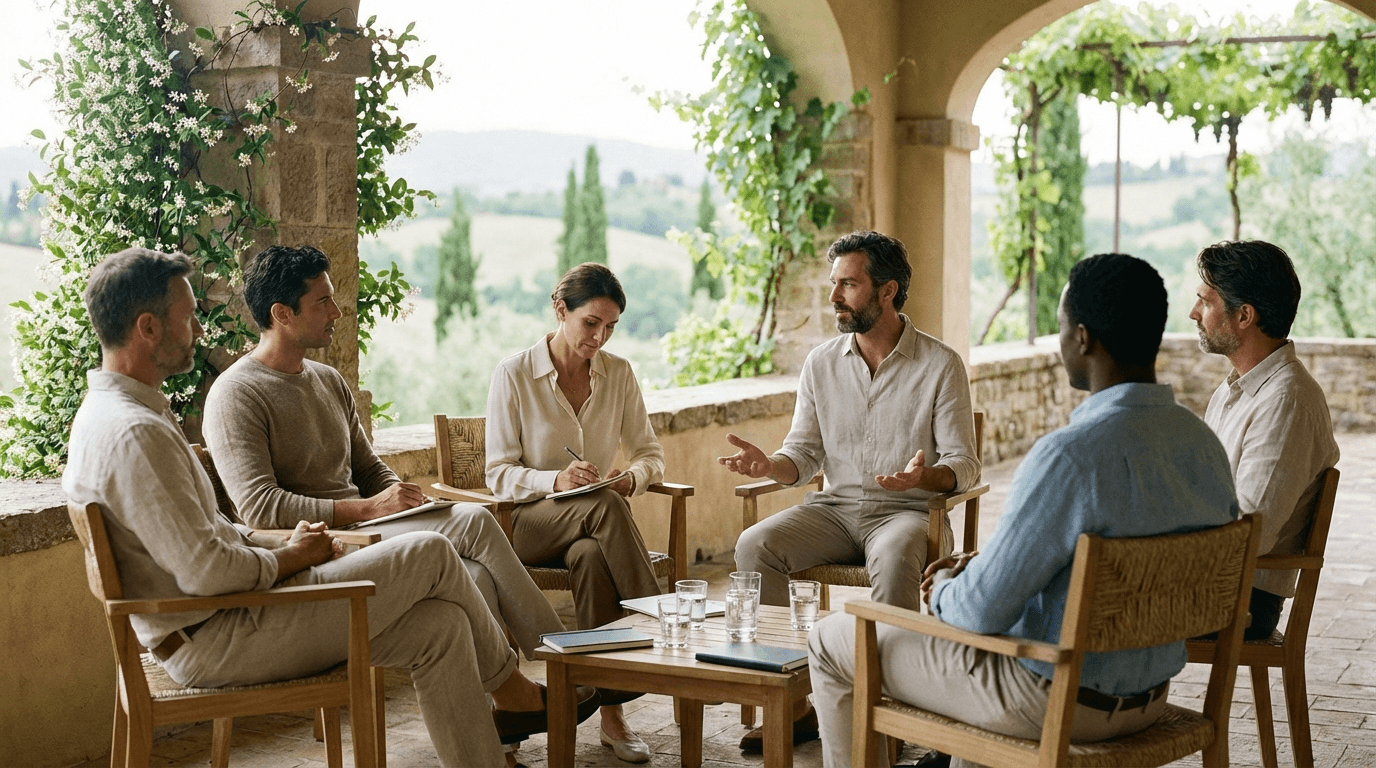
In Tuscany, for example, many leadership retreats draw on the region’s tradition of reflective practice. Time is intentionally set aside for structured dialogue, often in environments that encourage distance from daily pressures without creating distraction. The landscape supports the work, but it does not replace it.
Creating a Shared Language Between HR and Team Leads
One of the most overlooked benefits of outcome-oriented retreats is the shared language they create between HR and Team Leads. Too often, these groups approach retreats from different angles, even when they share the same goals.
HR typically thinks in terms of culture, engagement, and long-term people development. Team Leads focus on delivery, performance, and immediate team dynamics. Both perspectives are valid, but when they are not aligned, retreats risk serving neither fully.
By framing retreats around concrete outcomes, both sides gain common reference points. Instead of debating whether the retreat was “successful,” they can discuss whether specific shifts occurred. Did meetings become more focused? Did responsibilities become clearer? Did collaboration across teams improve?
This shared language also makes follow-up more effective. HR can design supporting measures that reinforce what was addressed during the retreat. Team Leads can connect insights from the offsite to everyday leadership decisions. The retreat becomes part of an ongoing process rather than an isolated moment.
In Italian organizations with strong regional identities, such as those based in Emilia-Romagna or Piedmont, this alignment is often more intuitive. There is a cultural emphasis on continuity between discussion and execution. Retreats are seen as extensions of work, not escapes from it.
What Outcome-Driven Retreats Look Like in Practice
Outcome-oriented retreats do not follow a single formula. Their design depends on context, team maturity, and organizational goals. However, certain patterns consistently appear when retreats lead to lasting change.
First, preparation is taken seriously. Participants are not expected to arrive with an open mind only. They arrive with shared questions, data points, or reflections that ground discussions in reality. This creates depth quickly and avoids superficial conversations.
Second, the agenda balances structure and openness. Key sessions are designed to address defined outcomes, such as clarifying decision rights or surfacing unspoken expectations. At the same time, space is left for informal exchange, which often deepens trust and understanding. The difference lies in intention, not rigidity.
Third, facilitators or partners play an active role. They are not there to entertain or simply keep time. Their role is to hold the outcome focus, challenge assumptions, and help teams articulate insights clearly. This external perspective often allows teams to address topics they might otherwise avoid.
In regions like South Tyrol, where multilingual and multicultural teams are common, retreats often emphasize explicit communication norms and decision frameworks. These practical outcomes have a direct impact on how teams function across linguistic and cultural boundaries.
The Emotional and Logical Case for Focusing on Outcomes
Focusing on team retreat outcomes appeals both emotionally and rationally.
On an emotional level, it respects participants’ time and intelligence. People sense when a retreat is designed with purpose. They feel taken seriously, not managed through morale-boosting gestures. This clarity often creates psychological safety. When teams understand why certain conversations are happening, they are more willing to engage honestly. Trust grows not because of forced bonding, but because the work feels relevant.
On a rational level, outcome-driven retreats provide a clearer return on investment. While not everything can or should be measured, it becomes easier to articulate value. HR can explain how the retreat supported specific cultural or organizational goals. Team Leads can link insights to improvements in collaboration or execution.
This dual value is especially important in environments where leadership teams must justify decisions to boards or stakeholders. A retreat framed around outcomes stands on firmer ground than one framed around experience alone.
Italy Is a Setting That Supports Depth, Not Distraction
Italy is often associated with beauty, cuisine, and lifestyle. These elements undoubtedly contribute to the retreat experience. However, their real value lies in how they support focus and presence when used thoughtfully.
Italian settings offer a sense of continuity and perspective. Historic towns, rural landscapes, and long-standing traditions remind participants that meaningful work often requires patience and reflection. When retreats are held in places like Umbria or the Italian Lakes, the environment naturally slows conversations down without diluting their seriousness.
Cultural practices also play a role. Shared meals in Italy are rarely rushed. They create space for dialogue that goes beyond surface-level exchange. When integrated intentionally, these moments reinforce trust and understanding, which are essential foundations for any lasting outcome.
The key is restraint. The destination should never overshadow the purpose. When the setting supports the work rather than competes with it, the retreat gains depth.
The Role of Partnership in Achieving Outcomes
Designing outcome-driven retreats is complex. It requires understanding team dynamics, organizational context, and logistical realities simultaneously. This is where partnership becomes critical.
HR and Team Leads already carry significant responsibility. Adding the role of retreat architect often stretches capacity and focus. External partners who understand both people dynamics and operational execution can hold the complexity without fragmenting attention.
The value of such a partnership does not lie in creativity alone. It lies in judgment. Knowing when to push a team, when to slow down, and when to let conversations unfold naturally is the result of experience. It is also what separates retreats that feel productive from those that simply feel pleasant.
In long-established Italian event cultures, particularly in cities like Florence or Milan, the role of the organizer has always been to create conditions for meaningful exchange. Modern team retreats benefit from the same philosophy, applied to contemporary organizational challenges.
From Before to After: What Actually Changes
Before outcome-driven design, retreats often leave behind good memories but little clarity. Teams return energized, yet unsure how to translate that energy into action. HR struggles to explain the impact beyond a general boost in morale. Team Leads sense potential, but lack concrete shifts to build upon.
After outcome-driven design, the difference is subtle but tangible. Teams share clearer expectations. Conversations reference insights from the retreat weeks or months later. Decisions feel more aligned. There is a sense that the offsite marked a turning point, not because it was extraordinary, but because it addressed what mattered.
This shift is rarely dramatic. It unfolds in how meetings are run, how feedback is given, and how responsibility is taken. These are the quiet indicators of real change.
A Final Reflection
Team retreats will always carry an experiential dimension. Removing that would miss their human value. The question is not whether teams should enjoy being together, but whether that enjoyment translates into better ways of working.
For HR and Team Leads operating at the intersection of culture and performance, focusing on team retreat outcomes offers a way forward. It reframes retreats as strategic moments, not isolated events. It aligns intention with design, and experience with impact.
If retreats are one of the few moments when your teams truly come together, it may be worth reflecting on what you want those moments to change. A thoughtful conversation can often clarify whether your current approach supports that ambition, or whether a different design could make the difference.